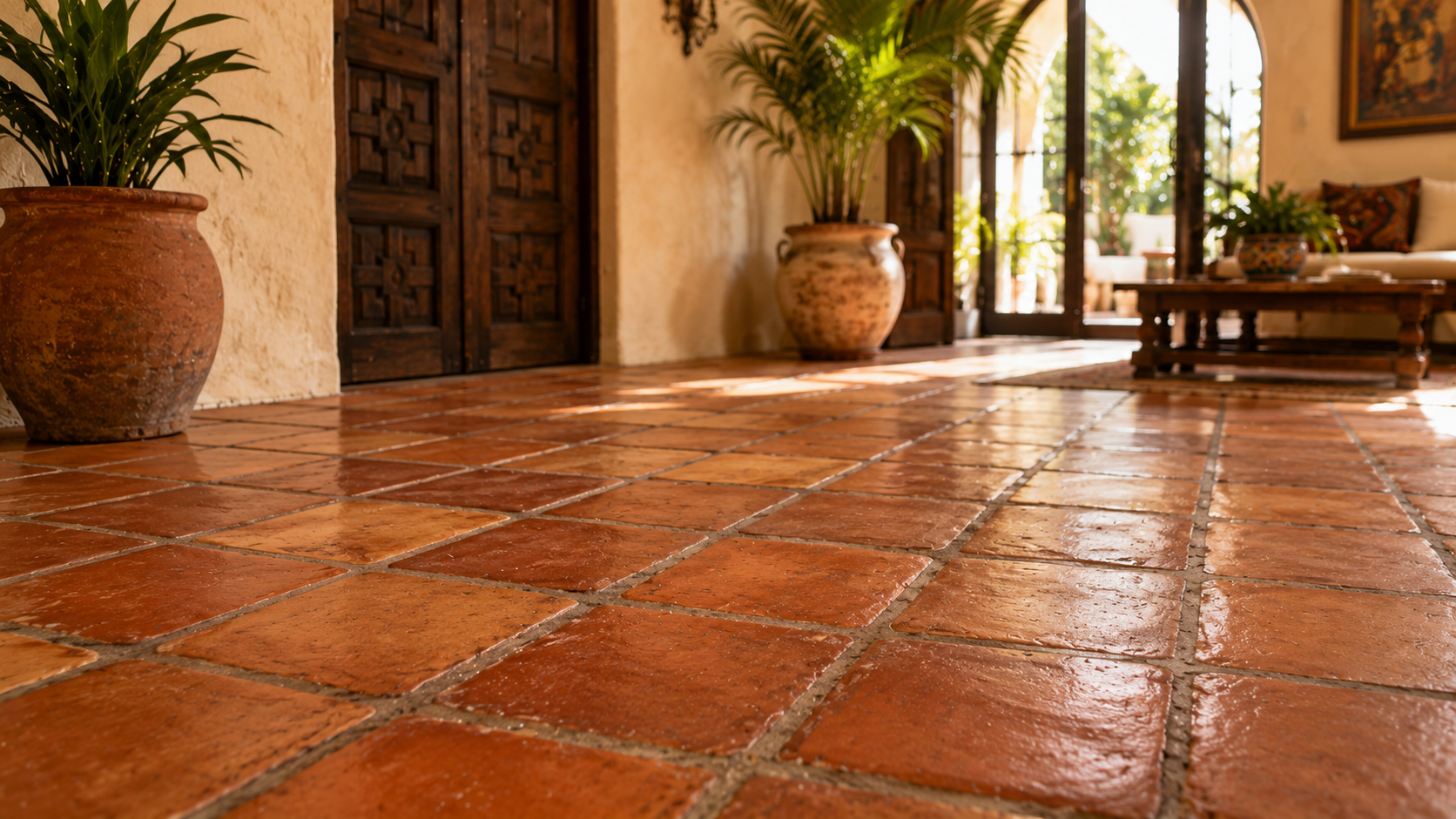
What Is Mexican Tile and Why Does It Need Special Restoration Care?
You just bought a home in Palm Beach County, perhaps a 1970s Mediterranean in Delray Beach, or a sprawling ranch in West Palm Beach, and the floors are covered in warm, earthy, hand-made-looking tiles. They're gorgeous, and a little rustic. You type what you see into Google, and out comes the word: Mexican tile.
And now the real question begins. What exactly is Mexican tile? And why does everyone who knows anything about it tell you to be very careful with how you maintain it?
Here is the honest, complete answer.
At BK Marble Restoration LLC, we help homeowners throughout Palm Beach County restore Mexican tile and Saltillo tile floors affected by South Florida's heat, humidity, moisture, and everyday wear. In many cases, floors that appear permanently stained, faded, or damaged can be restored without the cost and disruption of replacement.
What Is Mexican Tile?
Mexican tile, also known as Saltillo tile, is named after the capital city of the Mexican state of Coahuila. It is a handmade clay paver tile, sun-dried and kiln-fired at relatively low temperatures. Each piece, shaped by hand or simple molds, is pressed from natural terracotta clay and baked until solid. This process has barely changed through the centuries.
Saltillo tiles are naturally porous, as they are handmade and fired at lower temperatures. The warm terracotta tones, reddish-orange hues, and natural variations in shape are what give Saltillo tile its character. This is what people like and what they pay for.
What homeowners often don't realize is that Mexican tile and Saltillo tile are the same thing. Professionals use both terms interchangeably. If you're searching for help with your floors, search for both; you'll find more of the right information.
Why Mexican Tile Is Popular in South Florida Homes
The architectural identity of South Florida has been largely shaped by the Spanish Colonial, Mediterranean Revival, and Old Florida aesthetics- styles that were built for heat, open courtyards, and a certain relaxed elegance.
Homes across Boca Raton, Delray Beach, West Palm Beach, and surrounding Palm Beach County have been laid with Saltillo tile for decades.
Its earthy appearance complements South Florida's Mediterranean-inspired architecture, while its natural texture and warmth make it a popular choice for patios, entryways, kitchens, and living spaces.
Why Saltillo Tile Requires Specialized Restoration
This is where it gets important. Professional Mexican tile restoration in Palm Beach County requires products and techniques specifically suited to Saltillo tile and South Florida's climate.
Since the Mexican tiles are made of porous, unsealed clay, they are highly susceptible to moisture, staining and surface breakdown, especially given the humidity of South Florida. Unlike ceramic or porcelain tiles, Saltillo tiles cannot simply be mopped with standard cleaners. Harsh chemicals strip the existing sealant, and a DIY cleaning project can permanently etch and dull the surface.
Over time, the original factory sealant wears away entirely. Without protection, the clay absorbs dirt, oils, pet waste, and moisture at the pore level. The tile doesn't just look dull; the damage goes deep. Stains that seem surface-level are often not.
Common Problems with Mexican Tile Floors
Dullness and Loss of Color
The warm terracotta tones that make the tiles distinct gradually fade as the sealant erodes. Without that barrier, daily foot traffic, dirt, and moisture begin to wear down the surface, leaving the floor looking flat, dull and lifeless.
Efflorescence
Efflorescence appears as a white, powdery residue on the tile surface. It occurs as white mineral deposits rise through the tile from below. This is triggered by the high-moisture environment of South Florida.
Cracking and Chipping
Unsealed tile absorbs moisture, which expands and contracts with heat cycles. Over time, this repeated stress can lead to chipping and even larger fractures.
Deep Staining
Substances such as grease, rust, mold, and the occasional pet accidents, and spilled beverages can penetrate deep into the clay through its pores, and ordinary cleaning is rarely enough to remove them completely.
Grout Deterioration
Grout between the Saltillo tiles, exposed to the same moisture and wear that affects the tile itself, darkens and breaks down over time.
The Importance of Professional Mexican Tile Restoration
Professional Mexican tile restoration does more than improve appearance. The goal is to protect the tile from future moisture damage, staining, and premature deterioration.
The process of restoring Mexican tiles includes stripping off the old, failed sealant down to the bare clay without damaging the body of the tile, which demands specialized stripping agents and professional equipment.
The floor is then deep-cleaned, the cracks are restored, and finally the surface is re-sealed with a penetrating sealer, appropriate for the tile’s porosity and the local climate. A professional who knows Saltillo tile restoration in Palm Beach County will choose products and processes calibrated for this specific environment.
When to Restore Instead of Replace Mexican Tile
Mexican tiles can almost always be restored rather than replaced. The process of replacement is often expensive, disruptive and unnecessary. Floors that look beyond saving, ones that are heavily stained, cracked, and chalky white with mineral deposits, typically respond extraordinarily well to professional restoration.
The clay body of Saltillo tile is robust; what fails is the protection around it, not the tile itself.
If the floor is original to a 1970s or 1980s South Florida home, restoring it rather than replacing it also preserves something genuinely irreplaceable: the warmth and imperfection that gives these homes their soul.
Ready to bring your Mexican tile floors back to life?
BK Marble Restoration LLC specializes in Mexican tile floor restoration and Saltillo tile restoration across Palm Beach County, Boca Raton, Delray Beach, and West Palm Beach. We understand these floors, the clay, the climate, and exactly what it takes to make them look the way they were meant to look.
Call us at (561) 201-5347 or visit bkmarblerestorationllc.co to get a free estimate. Your floors have more life in them than you think.